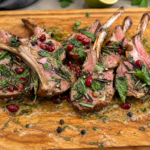
Floribbean Rack of Lamb with Roasted Garlic Lime Butter Flavor Board
What happens when you cook a beautiful rack of lamb without a single grain of seasoning?
No salt. No pepper. No herbs.
Instead of seasoning the lamb before cooking, this recipe builds all of the flavor at the end. The rack is hard-seared, gently finished in the oven, then placed directly onto a flavor board layered with roasted garlic, lime butter, fresh rosemary, flaky sea salt and cracked black pepper.
As the hot lamb rests and is sliced, its natural juices mingle with the butter, garlic and herbs to create a rich finishing sauce. Fresh mint and pomegranate add brightness and contrast.
This isn't meant to prove that seasoning meat beforehand is wrong. It's a different approach—and a great reminder that sometimes changing when flavor is introduced can completely change the eating experience.
Servings: 4 servings
Ingredients
For the Rack of Lamb
- 1 Frenched rack of lamb approximately 1½–2 pounds
- 1 –2 tablespoons neutral high-heat cooking oil for searing
- That's it. Do not season the lamb before cooking.
For the Roasted Garlic Lime Butter
- 6 tablespoons unsalted butter softened
- 4 cloves roasted garlic mashed
- Zest of 1 lime
- 1 –2 teaspoons fresh lime juice
For the Flavor Board
- Prepared Roasted Garlic Lime Butter
- 1 tablespoon fresh rosemary finely chopped
- ¾ teaspoon flaky sea salt plus more to taste
- ½ teaspoon freshly cracked black pepper plus more to taste
- 2 tablespoons fresh mint leaves torn
- 2 –3 tablespoons fresh pomegranate arils
Instructions
Prepare the Lamb
- Remove the lamb from the refrigerator and pat it thoroughly dry.
- Trim away any loose flaps, exposed silverskin or hard exterior fat that is unlikely to render, but do not aggressively remove the fat cap.
- If necessary, clean the exposed rib bones. Chef Winston's butcher trick is to wrap butcher's twine firmly around the bone and pull downward to help remove the remaining meat and connective tissue instead of repeatedly scraping the bones with a knife.
- Lightly score the fat cap in a shallow crosshatch pattern, being careful not to cut into the meat.
- Do not season the rack.
Make the Roasted Garlic Lime Butter
- Combine the softened butter, mashed roasted garlic, lime zest and lime juice.
- Mix until evenly incorporated.
- Set aside at room temperature while the lamb cooks.
Sear the Rack
- Preheat the oven to 375°F.
- Heat a heavy oven-safe skillet over medium-high to high heat until hot.
- Add enough high-heat oil to lightly coat the pan.
- Place the lamb fat-side down and sear until a deep golden-brown crust develops. Rotate the rack as necessary to brown the other exposed surfaces.
- Remember: still no seasoning.
- The goal here is crust development and color.
Finish in the Oven
- Transfer the rack to the preheated oven.
- Roast until the thickest part of the meat reaches approximately 125°F for medium-rare.
- Cooking time will vary depending on the size and thickness of the rack, so rely on internal temperature rather than the clock.
Build the Flavor Board
- While the lamb finishes, spread the Roasted Garlic Lime Butter across the center of a clean cutting board or serving board.
- Scatter the chopped rosemary over the butter.
- Season the board with the flaky sea salt and freshly cracked black pepper.
- This is where the seasoning that would traditionally have gone onto the raw lamb is waiting.
- Let the Lamb Meet the Flavor
- Remove the rack from the oven and place the hot lamb directly onto the prepared flavor board.
- Allow it to sit briefly—approximately 60–90 seconds—while the heat begins melting the butter and releasing the aroma of the rosemary and roasted garlic.
- The lamb should carry over toward approximately 130–132°F for medium-rare.
Slice and Coat
- Slice the rack between the bones into individual or double chops.
- As the lamb is sliced, the released juices will combine with the melted lime butter, roasted garlic, rosemary, salt and pepper on the board.
- Turn or gently drag each chop through the mixture so the cut surfaces pick up that finishing sauce.
This is the key to the technique:
- The flavor comes LAST.
Finish Fresh
- Tear the fresh mint over the lamb.
- Scatter the pomegranate arils across the board.
- Give the chops one final turn through the buttery herb-and-lamb-juice mixture and serve immediately.
Video
Notes
Chef Winston's Notes
Don't over-trim the rack. The fat cap is part of what makes rack of lamb flavorful. Remove what won't contribute to the finished dish, but don't strip away good fat unnecessarily.
Use temperature, not time. Rack thickness varies. An instant-read thermometer is far more reliable than cooking by minutes alone.
Why sear first? Reverse searing is a useful technique, particularly for thick cuts where precise edge-to-edge doneness is important. For this rack, I preferred building the crust first and then allowing the oven to gently finish the interior.
Don't drown the lamb in butter. The goal is for the butter, garlic, herbs, seasoning and lamb juices to become a finishing sauce—not to bury the flavor of a premium piece of meat.
Add mint last. Keeping the mint fresh preserves its aroma and gives the rich lamb a brighter finish.
Use the pomegranate with restraint. You're looking for occasional bursts of sweetness and acidity, not pomegranate in every bite.
The Experiment
Would I say this technique replaces seasoning lamb before cooking?
No.
It creates a different eating experience.
When you season before cooking, the seasoning becomes part of the crust and cooking process. Here, the seasoning remains part of the finishing sauce, coating the freshly sliced meat along with the butter, roasted garlic, herbs and natural lamb juices.
That's what made this experiment interesting. After more than 30 years of cooking professionally, it's a reminder of something I still believe:
Good cooking isn't about following every trend. It's about understanding why a technique exists and knowing when it makes sense to use it. And sometimes the only way to find out is to cook it.
Bring your fork or bring your feelings. Either way, I'm bringing flavor.
Would I say this technique replaces seasoning lamb before cooking?
No.
It creates a different eating experience.
When you season before cooking, the seasoning becomes part of the crust and cooking process. Here, the seasoning remains part of the finishing sauce, coating the freshly sliced meat along with the butter, roasted garlic, herbs and natural lamb juices.
That's what made this experiment interesting. After more than 30 years of cooking professionally, it's a reminder of something I still believe:
Good cooking isn't about following every trend. It's about understanding why a technique exists and knowing when it makes sense to use it. And sometimes the only way to find out is to cook it.
Bring your fork or bring your feelings. Either way, I'm bringing flavor.