
Floribbean Salmon Burger with Plantain Bun
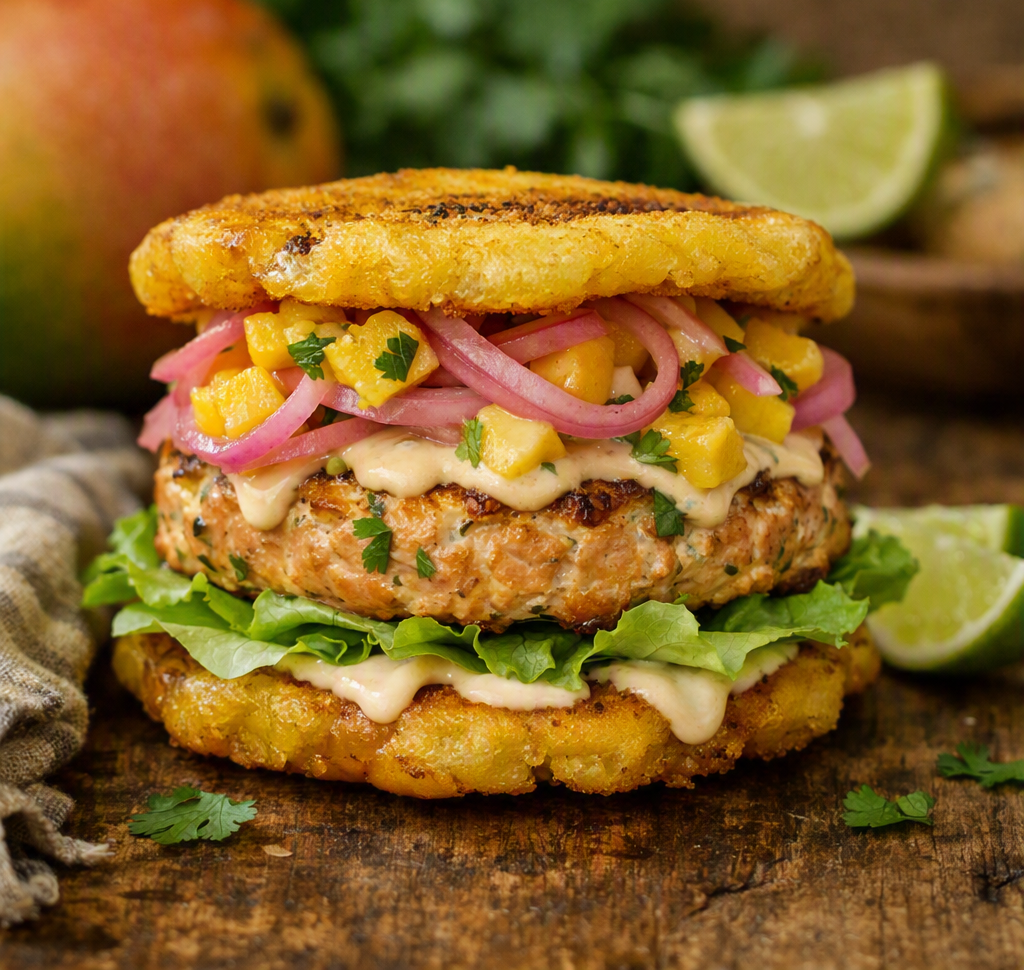
A Floribbean Salmon Burger is my way of taking something everybody already knows and looking at it completely differently. Instead of putting my salmon burger between a traditional bread bun, I’m building it between two twice-fried plantains and layering it with Caribbean Mango Chow, Floribbean Citrus Aioli, butter lettuce, and quick pickled red onion.
I like to color outside the lines a little bit.
Everybody knows what a salmon burger is supposed to look like. You have your salmon patty, your toppings, and your bun. But I wanted to ask a different question: what happens when I take the bun out of the equation and replace it with plantain?
That’s where this Floribbean Remix begins.
The plantain isn’t sitting on the side of the plate. It isn’t just another topping. I’m using it as the actual bun, and that changes the way the entire burger comes together.
This is what I mean when I talk about Floribbean Remix. I’m taking something familiar and reimagining it through the flavors and influences of Florida and the Caribbean.
And in this case, the result is one seriously different salmon burger.
Why I Created This Floribbean Salmon Burger
When I started thinking about this burger, I didn’t want to make another salmon burger and simply add Caribbean flavors to it.
That’s too easy.
I wanted to change something fundamental about the burger itself.
The bun was the place to start.
Plantains are an ingredient I know and love, and I wanted to see if I could take a familiar Caribbean ingredient and give it a completely different job. Instead of serving it as a side, I wanted it to become the structure that holds the burger together.
That meant I had to think about texture.
A traditional burger bun has to hold the filling without falling apart. So if I’m going to use plantain as my bun, I can’t just fry it until it’s hard and brittle.
I need it to have some structure.
I need those golden, crisp edges.
But I also need it to stay a little pliable in the center.
That’s why the plantain preparation is such an important part of this burger.
And once I had the plantain bun figured out, I could build the rest of the burger around it.
The Plantain Bun Is the Big Remix
The first thing you’re going to notice about this burger is the plantain.
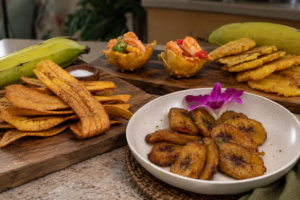
I use semi-ripe plantains that are mostly green but still have a little pliability. I peel them, cut them into sections, and start with the first fry.
Once they’re softened from that first fry, I gently smash them into rounds.
When I filmed the episode, I used a tortilla press to help create that circular burger-bun shape. It makes the process straightforward, but the important part is handling the plantain gently and getting the shape you need.
Then I fry them again.
This second fry is where the texture really comes together.
I’m looking for golden color and crisp edges, but I’m not trying to turn these into hard, brittle tostones. Remember, I’m making a bun.
If the plantain gets too crispy, it can crumble when you try to eat the burger.
I want that little bit of crispness on the outside while keeping enough tenderness and pliability in the middle to hold everything together.
That’s a completely different way of thinking about plantain.
I’m not making a side dish.
I’m building a bun.
If you want the complete technique for making these separately, I’ll have the Plantain “Bun” recipe available.
Building the Salmon Burger
Now let’s talk about the other star of the show: the salmon.
I start with fresh salmon, remove the skin, and hand chop it.
I don’t want to turn the fish into a completely smooth mixture. I like to leave some texture in the salmon, so when you look at the finished patty, you can still see that you’re working with real pieces of salmon.
From there, I build the flavor with green onion, garlic, fresh thyme, lime zest, orange zest, smoked paprika, allspice, black pepper, salt, Dijon mustard, panko breadcrumbs, and the other ingredients in the recipe.
I also use my Cajun Dust.
That’s another layer of flavor in the burger, and I give the finished patties a light dusting before they hit the griddle.
The important thing here is not to overwork the salmon mixture.
I fold everything together gently, form the patties, and then let them rest in the refrigerator before cooking.
That refrigerator rest is part of the process.
Once the patties are ready, I get the griddle hot, add a little oil, and let the salmon burgers sear.
I’m looking for that beautiful golden-brown exterior while making sure the salmon is cooked through.
And salmon doesn’t need a long cooking time.
In the episode, I check the internal temperature as the burgers finish cooking, looking for that properly cooked center rather than leaving them on the griddle longer than necessary.
That’s how I want the salmon to meet the plantain bun: nicely formed, flavorful, and still worthy of being the star of the burger.
The Freshness Comes From Caribbean Mango Chow
Once I had the salmon and plantain figured out, I knew I needed something fresh to bring everything together.
That’s where my Caribbean Mango Chow comes in.
And let me make something clear:
I’m not making mango salsa.
There’s a difference.
When I make this chow, I’m looking for acidity, freshness, and a little kick of heat.
I start with ripe but firm mangoes, then bring in red onion, cilantro, culantro, lime juice, and Scotch bonnet pepper. The result is bright, fresh, and tangy.
That’s exactly what I want alongside the salmon.
The salmon brings a rich, savory element to the burger. The plantain gives me the bun. The chow brings freshness and acidity into the combination.
The mango is not supposed to turn this into a sweet fruit-topped burger.
I want the mango to still taste like mango, but I want the lime, herbs, onion, and Scotch bonnet to give it enough character to stand up to everything else.
That’s why I specifically say in the episode that you want bright, fresh, tangy flavor—not a sweet fruit topping.
You can find the complete Caribbean Mango Chow recipe separately.
My Floribbean Citrus Aioli
Then I bring in the sauce.
My Floribbean Citrus Aioli gives the burger that creamy element, but I don’t want it to be just mayonnaise with a little lime squeezed into it.
I build the flavor with roasted garlic, lime, orange zest, honey, and Scotch bonnet.
The result is creamy, citrus-forward, with roasted garlic and Caribbean heat.
That citrus is important because it gives the burger another bright element, while the roasted garlic adds depth to the sauce.
I also let the aioli rest before serving so the flavors have time to come together.
I’m keeping the exact formula for this aioli proprietary, so you won’t find the complete measurements for it here. That’s intentional. The sauce is part of my protected Chef Winston content for future cookbook and premium use.
But you don’t need the exact formula to understand what it’s doing in this burger.
It brings creaminess.
It brings citrus.
It brings roasted garlic.
And it brings Caribbean heat.
That’s its job.
Why the Pickled Red Onion Belongs Here
I also add quick pickled red onion to the final build.
I love what that brings to the burger because now we’re adding another tangy element to a combination that already has a lot going on.
The pickled onions bring their own sweetness and tanginess, and they work with the mango chow rather than competing with it.
That’s important to me.
I don’t want every ingredient doing the same thing.
The salmon has its job.
The plantain has its job.
The mango chow has its job.
The aioli has its job.
The pickled onion has its job.
The lettuce has its job.
When all those pieces come together, you get a burger with different flavors and textures working in the same bite.
If you want to make the onion component separately, you can use my Quick Pickled Red Onion recipe.
How I Build the Floribbean Salmon Burger
This is where everything finally comes together.
I start with the bottom plantain bun.
Then I add the Floribbean Citrus Aioli.
Next comes the butter lettuce.
Then I place the salmon burger right on top.
After that, I add the Caribbean Mango Chow.
Then I bring in the quick pickled red onion.
I finish with another little layer of the citrus aioli on the top plantain before placing it over everything.
And that’s the burger.
Plantain. Aioli. Lettuce. Salmon. Mango Chow. Pickled Onion. Plantain.
Look at what happened.
We started with the basic idea of a salmon burger.
But by changing the bun and building the rest of the components around that change, we’ve created something completely different.
That’s the transformation I was looking for.
The Trick to Getting the Plantain Bun Right
If you’re making this burger, pay attention to the plantain.
This is probably the component where you can most easily go wrong if you treat it like a regular tostone.
I don’t want that.
I want the plantain to function as a bun.
That means I don’t want it fried until it becomes so crisp that it breaks apart.
After the first fry, smash it gently.
Then fry it again until you get that beautiful golden color and crisp edges, but leave enough tenderness in the center.
The stage of ripeness matters too.
I’m using plantains that are mostly green but still have a little pliability. That’s intentional.
The plantain needs enough structure to become the bun, but it also needs to be workable enough to smash after the first fry.
Once you understand that you’re building a bun rather than simply making fried plantain, the technique makes a lot more sense.
Don’t Overwork the Salmon
The same thinking applies to the salmon.
I don’t want a completely smooth salmon paste.
I hand chop the salmon and leave some texture.
Then I fold the mixture together gently rather than aggressively mixing it.
Once the patties are formed, I let them rest in the refrigerator before cooking.
That gives me the structure I’m looking for when the patties hit the griddle.
And when they cook, I pay attention.
Salmon doesn’t need a long cooking time, so I watch the burgers as they sear and check the internal temperature as they finish.
I’m looking for that beautiful caramelized exterior and a properly cooked center.
The goal isn’t to cook the salmon longer just because we’re making a burger.
It’s to cook it properly and let the rest of the ingredients do their jobs.
The Balance Is What Makes the Burger Work
One of my favorite things about this burger is that no single component is trying to do everything.
The salmon is savory and flavorful.
The plantain gives me the unexpected bun.
The mango chow gives me fresh, tangy flavor and Caribbean heat.
The citrus aioli gives me creaminess, roasted garlic, and citrus.
The pickled red onion gives me another layer of tanginess and sweetness.
The lettuce adds freshness.
That’s a lot happening in one burger, but the components aren’t fighting each other.
They’re balancing each other.
That’s why I didn’t want to simply make a salmon burger and throw a few Caribbean ingredients on top.
I wanted to build the whole thing intentionally.
This Is What Floribbean Remix Means to Me
This burger is a good example of what I’m trying to do with Floribbean Remix.
I’m not interested in making something different just for the sake of saying it’s different.
I’m interested in taking food that people already understand and asking what else it could become.
A burger is familiar.
Salmon burgers are familiar.
Plantains are familiar.
Mango is familiar.
But put those ideas together in the right way, and suddenly you’re looking at something that feels completely different.
That’s where the Florida and Caribbean influences come together for me.
My cooking has been shaped by my Virgin Islands upbringing and my professional culinary experience in Florida, and this kind of dish gives those influences a place to meet.
I’m taking something recognizable and looking at it through that lens.
That’s the whole point.
It’s Not Fusion Just to Be Different
There’s something else I want to make clear about this kind of cooking.
I don’t want to add Caribbean ingredients just so a dish can be called Caribbean.
Every component needs to have a reason for being there.
The plantain isn’t there just because it’s Caribbean.
It’s the bun.
The mango chow isn’t there just because mango is associated with the Caribbean.
It brings the acidity, freshness, and heat that the burger needs.
The Scotch bonnet isn’t there just to make the dish hot.
It gives the chow and aioli their Caribbean character and adds heat where it belongs.
The citrus isn’t there just because it sounds tropical.
It brings brightness to the salmon and the sauce.
That’s the difference between adding ingredients and actually building a dish.
How I Like to Serve It
Once I have everything ready, I want to bring the burger together and enjoy it as one complete bite.
Don’t separate the components.
The whole point is to get the plantain, salmon, mango chow, aioli, lettuce, and pickled onion working together.
That’s where you get the contrast.
That’s where you get the texture.
That’s where you get the full Floribbean experience.
In the episode, I described this as a summer dish, and I could absolutely see sitting down with a glass of rum punch and enjoying it.
But honestly, the best part is that first bite when you finally get to see whether the whole idea actually works.
So, Can Plantain Replace the Bun?
That’s the question I started with.
Can plantain actually replace the traditional burger bun?
After putting this burger together and taking that first bite, I knew the answer for me.
Yes.
But it’s not simply because plantain can physically hold a burger.
It’s because the plantain changes the character of the entire dish.
The salmon still tastes like salmon.
The burger still feels like a burger.
But now you’re getting that twice-fried plantain with it, along with the citrus aioli, Caribbean Mango Chow, pickled onion, and lettuce.
And that’s what makes the combination special.
This is not just a salmon burger with a clever substitute for bread.
It’s a different way of building the burger.
That’s what I wanted when I started this experiment.
What This Burger Is Really About
For me, this creation is about looking at familiar food differently.
You don’t have to throw away everything you know about a dish to make it your own.
Sometimes you just have to ask a different question.
What if the bun wasn’t bread?
What if plantain became the foundation?
What if mango chow wasn’t a side but part of the burger?
What if citrus, roasted garlic, and Caribbean heat became the sauce that tied everything together?
That’s how I approach Floribbean cooking.
I take the flavors and instincts I know and look for new places where they belong.
And that’s exactly what happened here.
A salmon burger became a Floribbean Remix.
Ready to Make the Floribbean Salmon Burger?
If you’ve been watching the episode and wondering whether the plantain bun actually works, now you can make the burger yourself.
The complete Floribbean Salmon Burger recipe is in the recipe card below.
For the supporting components, make the Caribbean Mango Chow and Plantain “Bun” separately, then bring them together with the Floribbean Citrus Aioli, butter lettuce, and quick pickled red onion for the final build.
The aioli formula remains proprietary, but you can still understand exactly what it contributes to the finished burger: creamy citrus flavor, roasted garlic, and Caribbean heat.
And when you put everything together, remember what this recipe is really about.
It’s not about making a burger different just for the sake of being different.
It’s about taking something familiar and reimagining it through the flavors of Florida and the Caribbean.
That’s what Floribbean Remix is all about.
Bring your fork or bring your feelings.
Either way, I’m bringing the flavor.
FLORIBBEAN SALMON BURGER
Ingredients
- 1½ pounds fresh salmon skin removed and hand chopped
- 1 large egg
- ¼ cup panko breadcrumbs
- 2 tablespoons finely diced green onion
- 2 cloves garlic minced
- 1 teaspoon fresh thyme chopped
- 1 teaspoon lime zest
- ½ teaspoon orange zest
- ½ teaspoon smoked paprika
- ¼ teaspoon ground allspice
- Fresh cracked black pepper
- Kosher salt
- 1 tablespoon Dijon mustard
- 1 tablespoon olive oil
Instructions
- Hand chop the salmon, leaving a little texture.
- Fold in remaining ingredients until just combined.
- Form into four equal patties.
- Refrigerate 15–20 minutes.
- Sear over medium-high heat for 3–4 minutes per side until beautifully caramelized and cooked through
One Response
I love a good salmon burger and this one right here is definitely a game changer and will absolutely be in my weekly rotation for sure 🙌 😋 👌